Wednesday, March 9, 2011

The Electric Michelangelo by Sarah Hall


337 pages Trade Paperback (Realistic Fiction)

I was in a used book store and as I looked around I found this colorful looking book. Having a lot of interest in Art I bought the book. As soon as I started reading it I was completely transfixed. It has been a while since I have been so engrossed in a book. I was carrying it with me everywhere, using every spare moment to pick it up and read a few pages.

The book focuses on the life of Cy in the early 1900’s. Cy’s father, a fisherman, died in a storm right before his birth. His mother runs a hotel that specializes in helping people with sicknesses, especially consumption. Hall weaves a tale of a small town and growing up in it. The village of Morecombe becomes a character on its own.
Although Cy is the main character and the story follows him, it goes deeply into the lives of those around him. It starts with his mother and what she goes through to support her son and the town they live in. It continues with Riley. This strange old man jumps into Cy’s life and leads him into the life of a tattoo artist. As time passes Cy eventually moves to America and sets up shop on Coney Island. As he becomes engrossed in strange life of a tattoo artist he meets a lady named Grace.
Sarah Hall is a fantastic writer. Her use of metaphor and simile are among the finest I have read. The characters are real and you get to see them from all sides. Cy is surrounded by strong people and his quiet nature keeps him from being fully known. Only after reading the whole book do you start to see the complexity of this main character.

Anyone with interest in literature will be engaged by this book. The writing, the characters, the story and the picture of the times makes each page worthwhile.

4 Emotional/intellectual: Each character in the book is interesting and in depth. I found myself being as involved with the “unlikeable” characters as the likeable ones.

5 Style/Readability: Considering I don’t know anyone that has heard of this writer I was blown away. Her style is fantastic and I was constantly engaged.

3 Long Term Impact: Hall isn’t a famous writer…YET. She has 4 books to her name and as time goes on I feel she will be more and more recognized for her great work.

12 out of 13: For a virtually unknown writer this is fantastic. Although this book may be slightly dense for some readers I think most will find this book very much worth their while.

Keep Turning Pages

Tuesday, March 1, 2011

Good Omens by Terry Pratchett and Neil Gaiman


369 Pages Trade Paperback (Fiction)

Good Omens is a collaboration by Pratchett and Gaiman written before either of them had really hit it as authors. The book starts out 11 years before the Apocalypse. An Angel and a Demon are at a hospital to witness the birth of the Anti-Christ. A quick switch by satanic nuns leaves the pair looking after the wrong child. Both characters think they are better off with the world staying as it is and think raising the child with an equal measure of good and evil will lead to a longer existence on earth.
11 years later we join with Newton Pulsifer and Anathema Device. Anathema is the distant relative of Agnes Nutter. Agnes is the only fully accurate witch to see into the future. Anathema ancestors have all been keeping track of and cross referencing Agnes’ predictions. Ananthema has realized that the end of the world is near. Newton Pulsifer just wants a job and soon finds himself working to rid the world of evil witches. This eventually leads him to Anathema and they soon are working to save the world.

The book is a lot of fun. The quirkiness of the characters makes for interesting things at every page. The Angel and the Demon make for the most fun using minor miracles to make their lives easier. It reads very easily and I was encouraged to keep reading whenever I had a chance.

After the story is done the writers both comment on how the book was made. Each wrote different parts. Then they would work over the phone finishing ideas and tuning other parts. It seems as if it was a true collaboration through and through.

Overall, it was a quick and enjoyable read. It was funny and engaging throughout

2 Intellectual/Emotional – It was a fun exersize in seeing the end of the world, but I never felt that invested in the book.

5 Readability/Style – Both writers are great and this book shows it on every page.

3 Long Term – Giaman and Pratchett are both famous writers. This collaboration will stand the test of time. That said, both authors have works that stand better on their own keeping it from earning a 4.

10 out of 13 – I think most readers would find this book worth their time. If you haven’t read either author I suggest this as a lead in and then check out their other books.

Keep Turning Pages

Thursday, February 10, 2011

The Gathering Storm by Robert Jordan/ Brandon Sanderson


766 Pages Hardcover (Fantasy Fiction)

This is the 12th book in the series of The Wheel of Time. If you are a regular reader of my blog you will probably notice that none of the first 12 books are on the blog. I started reading this series about 12 years ago. I was very interested in the books and the series especially up through the 6th book. After that I lost interest overall, but continued to read the series. After the 11th book was printed Robert Jordan died. He knew this was happening and Brandon Sanderson was hired to finish the series. Jordan had written a large part of the final book and the rest was written out as notes. After his death is was decided to break the book into 3 volumes. This is the first of those books.
If you haven’t read the books up to this point and care about spoilers skip to the end where I grade the book. In fact most of this review won’t make sense since it will assume you know most of the story so far.
A great storm is growing across the land. Everyone is covered in a cloudy sky that never goes away. Everywhere you look bad things are happening. The taint of the Dark One is revealing itself across the land. It is springtime, but crops aren’t sprouting, food is rotting unnaturally fast and buildings rearrange themselves overnight.
The book focuses on two characters. One is Egwene. In the previous books the White Tower, home of the Aes Sedai, has been split in two. A rebel force has a standing army at siege with the tower. Elaida, a crazy Red Aes Sedai, has been raised to the Amyrilyn Seat and has disbanded the Blue Ajah. Egwene was seated as Amyrilyn in the Rebel camp, but was then taken captive by the White Tower. A large part of the book focuses on her struggles to gain power within the tower. Egwene also finds out information regarding the Black Ajah and attempts to bring their existence to the light.
Rand Al’Thor, the Dragon Reborn, struggles with pretty much everything. His main goal is to get the Seanchan to stop their war with him so that they can focus their efforts on the Final Battle. He must also feed his armies. Most importantly, he must prepare himself for the final battle. The pressure continues to build and the only option he sees is to make himself hard. By hardening himself he starts to give up the things that he hopes to defend. Besides this he must deal with two of the forsaken. Semirage has been captured and attempts at getting information are hindered by Rand’s veto on torture. Greandal has been eluding Rand, but he works hard to eliminate her. His friends and advisors do what they can to show him how to feel again. Rand feels that if he gives in to his emotions than he won’t be able to do what is required of him.
Sanderson has done a great job of taking over this series. Personally, I think this has been the best book since the 6th. Jordan had added so much to the series and all this political intrigue had gotten bloated and uninteresting to follow. Sanderson had the benefit of bringing the story to a close. So many things had been left undone and he is the one that gets to present the problems being solved.
The style of the books continues in the vein of Jordan. Sanderson takes things from Jordan and makes it a part of his writing. Examples of this are Women “sniffing” when they are annoyed or men “knuckling” their mustache when uncomfortable. Unfortunately, this leaves a reader with a feeling like the book is somewhat immature. By this I don’t mean immature writing, but that it is written for younger readers. When making comparisons to other writers such as George R.R. Martin and Stephen Erickson the characters don’t seem as real. This is a fantasy series and I may have been spoiled with other more realistic fantasy writers.
3 Emotional/Intellectual: This book was a page turner and I was mostly invested in Egwene struggles. Her inner monologue made for the best part of the books.
3 Style/Readability: This is a tough one. The style of the book was somewhat annoying at times, but I feel like this was a compromise of Sanderson’s to continue with Jordan’s legacy. That said, I did get into the book and looked forward to reading more.
3 Long Term Impact: This series is already set as a major part of Fantasy Fiction. Regardless of how I feel about it is going to last for quite some time. Also this is one of the better book s of the series. Realistically, I feel that as time passes The Wheel of Time is going to be overshadowed by better series.

9 out of 13. From my perspective the whole series should have gone like this: Take books 1-6, then take the events of books 7-11 and put them into one or two books and cut out a lot of the unnecessary chaff. Then continue with this book and finish out the series. I plan on reading the rest of the books. I have gotten this far so I’ll finish it. That said, I wouldn’t recommend this series to a new reader. If you have read a lot of the series it is worth your time to continue. If you haven’t started pick up another writer.

Keep Turning Pages

Thursday, January 13, 2011

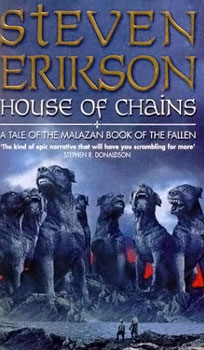
House of Chains By Steven Erikson


1015 page (Paperback)
Fantasy Fiction

This is the 4th book in the Tale of the Malazan Book of the Fallen series. The first section of the book follows the adventures of Karsa Orlong. As the book continues Erikson adds to the tale that was told in the second book, Deadhouse Gates.

Karsa Orlong comes from a history of warriors. He plans on returning his tribe to glory. He is joined by two other warriors, Bairoth Gild and Delum Thord. The three young men start a trek across the lands of their enemies leaving a trail of blood in their wake. As they continue on they see that much of the lands have been abandoned. After furthering their travels they are lead to places they never expected.

As the book continues we are drawn back to the conflicts laid down in Deadhouse Gates. Adjunct Tavore has been given the lead of the Empress’ army that consists mostly of new recruits. Her goal is to walk into the Whirlwind and take on Sha’ik’s Army of the Apocalypse. Much of the book focuses on the interactions of the various characters and the buildup to the impending battle.

Crokus, now known as Cutter, and Apsalar search for the Throne of Shadow on a mysterious moving island. Two new characters, Trull Sengar, a Tiste Edur, and Onrack, a T’lan Imass, quest through various warrens of magic. A friendship seems to form as their story starts to intersect with the other characters in the book.

This book takes a lot of the elements from the previous three books and startes to tie things together. We experience The Crippled God manipulating to come to power. The other gods also been use their influence to set themselves up to an advantageous position.

Erikson fills his writing with promises of returns in the future. He gives the reader tidbits of information to help flesh out the whole, but never gives you enough to really know the whole story. His writing is superb and easy to get involved in. Although, I am close to 4000 pages in I can’t claim to know even half of what the story is, but at the same time I feel as if a promise has been made that will be fulfilled by the end of the books. The characters have been much more fleshed out. Karsa, who was previously an unnamed character in the series, goes through enormous growth throughout the three years that passes in the book.

I felt as if this book was in some way filler in between the other books. That isn’t saying that it wasn’t worthwhile, but that a lot of the back story needed to be told to tell what is going to happen in the future books. Roughly three years have passed and that time shows us how we get to the confrontation of the two armies.

So far as the fantasy genre goes this series is one of the best I have read and I am excited to see how the rest of the story plays out.

3 Intellectual/Emotional: Karsa seems to be the main character of the book and his growth is a highlight of the book.

5 Style/Readability: Erikson’s ability to draw you into the story and create a world that seems real is fantastic.

3 Long Term: Eventually Erikson will be added to the greats of fantasy writing and this series will be towards the top of the list. That said, this book probably won’t be considered the “best” of the series.

11 out of 13. If you think you would enjoy a fantasy series that you can devote a year to, you should be reading this series. Those that are looking for some light reading may want to look elsewhere. Erikson writes for those that are willing to devote themselves to a book for awhile.

Keep Turning Pages

Monday, November 29, 2010

Neverwhere by Neil Giaman


370 Pages (Trade Paperback)
Fantasy Fiction

This is the first book I have read by Neil Giaman. I have heard of other stories and seen a couple movies based off of his books. I was pretty sure that I would be impressed with his writing.

Richard Mayhew is living the typical life of a middle aged Londoner. He is engaged to be married, has a steady job and is blissfully letting life pass him by. One evening on the way to dinner he finds a woman lying, bleeding on the ground. Against the warnings of his fiancé; he helps the woman. The woman, named Door, pleads not to be involved with a hospital or police. Richard has no choice but to take her to his place.

The following morning a strange pair of men show up at Richard’s apartment. They burst in the room and start searching for Door. They find nothing and leave him. Door seems to have quickly recovered from her injuries and, after talking to a bird and a rat, leaves. Richard starts to go back to his normal life when things start to take a strange twist. He hails taxis and they ignore him. He tries to interact with people and the act as if he isn’t there or quickly forget about him. He goes to work only to find that his desk has been cleared off. He soon finds that he has become a part of London Below. The place where people who fall through the cracks end up. He has to quickly learn how to survive in a place where nothing aligns with London Above. He eventually finds the Lady Door, who he helped, and is drawn into a mystery involving the death of her entire family.

Gaiman’s writing is easy to read. The story itself gets twisted and turned you seem to be lead one way only to be lead another. Interesting characters and a dreary background make this story what it is. A reader can take nothing for granted as the values of London Above mean little Below. Monsters and Monks are more common than money. Magical abilities are not uncommon and Rats sit atop the hierarchy of society. Only by joining with a unusual set of characters does Richard have any hope of returning to the life that has forgotten him.

I found Neverwhere to be a light read that was still entertaining. A teenager would be able to read this, but there is enough for an adult to enjoy.

Emotional/Intellectual 2 – I did enjoy reading this, but nothing stuck out as extremely dramatic.

Style/Readability 5 - Gaiman light hearted style combined with easy reading is a boon to the book. I was easily immersed and wanted to keep read each night. His

Long-Term Impact 2 – Gaiman has made a significant impact on the slightly strange side of things. His popularity deserves to only grow more. That said, other books of his will most likely be what make this possible.

9 out of 13. I did enjoy it and suggest it. I do feel that I may get more out of some of his other books once I get to them. That said, I certainly will be giving those others a try.

Tuesday, November 16, 2010

The Satanic Verses by Salman Rushdie


561 pages (trade paperback) Fiction

This book had a ton of press in the late 80’s and early 90’s. As most people know the Islamic reaction to this book was extreme and caused quite a commotion between different countries. This included a fatwa on Rushdie’s life that eventually held an almost 3 million dollar reward. There are a number of things in the book that a follower of Islam could find insulting. My understanding is the biggest problem stemmed from a poor translation of the title made it seem as if Rushdie called the Qur’an satanic. There are also depictions of people that have the same name or similar names to characters from the Qur’an. This is a violation of Islamic tradition that does not allow visual depictions of the religious test. Of course they are not drawn in the book, but are described in detail.

I attempted to read this when I was in high school, but both it’s foreign subject matter and dense writing style made it hard for my 17 year old brain. I eventually picked up other Rushdie books and have become a huge fan since. Anyone that reads my reviews will know that I am usually extremely pleased with his writing.

Unfortunately, to understand this book some spoiling is necessary. Part of this is just me attempting to understand all that is going on. I won’t try to reveal anything too important.

The book follows the lives of two men. Gibreel and Saladin. The book begins with both of them flying over the English Channel for different reasons. The plane cracks up and these two are the only ones to survive. They are found by a strange old woman and at that point there lives take a fantastic switch. Saladin starts to turn into a Devil. Gibreel gains a halo and becomes an Angel.

Their lives split apart. One takes the good life and the other drops into misery after misery; matching their newfound bodies. As this happens they start to go into dream like trances. It is as if they both have two lives. One: The continuation of their old life now being experienced in a new body. Two: A dream world that seems to be in the past. It is in this dream world that the cause of all Rushdie’s fatwa troubles is written. I am not a Muslim scholar. In fact I really don’t know much about Islam other than what a small amount of research tells me. My understanding is that in the dream we experience a “parody” of Mohammed’s life. Rushdie writes about people taking on the persona of famous people from The Prophet’s life. These people are poets, prostitutes, beggars and thieves.

This part of the book became very hard for me the first time around. Now, as a more experienced literary reader I still had difficulty. At first it isn’t made clear that you are in a “dream sequence”. For me it was if a different story was being told. It wasn’t until much later is it revealed that as the two main character go into these “trances” they are leading a separate life.

As always I find Rushdie’s writing to be fantastic. He has a style that is joyful to digest. He could be writing about anything and it would be good just for the construction of words and sentences. That said, this is probably one of the hardest books I have ever been successful at finishing. The main characters are Indian. Although I have a better understanding of Indian life then some, I am barely a novice when it comes to the culture. Knowledge of things such as jobs and names and locations are taken for granted. This book requires effort to read. This isn’t a Stephen King, thriller page turner. (I am not putting him down only making a comparison.) With that in mind, I really did enjoy the story. There are twists and turns. Rushdie’s ability to take the world as we know it, splash some fantasy in it, then tell a gripping story is as evident here as any of his other books.

3 Intellectual/Emotional – It is easy to imagine yourself being thrown a curve ball as these two men have. Coming to grips with their new life is a large part of the story.

4 Readability/Style – Rushdie’s writing is a pleasure. His ability to make small things a joy to read is done with an ability that few modern writers can match.

5 Long-Term Impact – This book is one of the poster boys of censorship in writing. It has been banned in countries around the world. Because of this it will have a long lasting place in the history of books. Even though I would not put this as my favorite of Rushdie’s writing even without the controversy surrounding the book it would stand on it’s own as great modern literature.

12 out of 13. I enjoyed this book very much. It was challenging and worthwhile. That said, this is NOT the place to start reading Rushdie’s books. I would suggest The Moor’s Last Sigh or Midnight’s Children. If you are not familiar with Indian writing or culture I might suggest you read some other people’s work to more familiarize yourself with it before delving into Rushdie. He is undoubtedly a great writer, but requires a lot of his readers to totally enjoy his books. I wouldn’t even claim to fully “GET” all that I read. BUT once you have the background and willingness to put in the effort this and all of his writing is worth your time.

As always,

Keep Turning Pages

Tuesday, October 19, 2010

Memories of Ice by Steven Erikson


775 pages (Fantasy Fiction) Trade Paperback

This is the third book in the Tale of the Malazan Book of the Fallen series. Erikson has been jumping around from continent to continent with each book. This book brings us back to most of the characters in the first book and continues their story on Genabackis. As the book goes on you realize that for the most part this is coinciding with the events that happened in the second book.

The Pannion Seer has raised an enormous army in the south. He brought about the Tenescowri, an army of people that have been driven to the brink of starvation, to the point of cannibalism. The battle centers itself in the city of Capustan. The local defenders known as the Grey Swords are set to defend themselves. A huge portion of the book focuses on how the members of the various armies and tribes start to sort themselves out. An uneasy alliance is formed between Dujek’s Army, Anomander Rake and the Tiste Andii, Silverfox and the T’lan Imass and Caladan Brood. They decide to join forces to work against the overwhelming armies of the Pannion Seer and his Tenescowri.

On the side, Toc the Younger, Tool the T’lan Imass, Lady Envy and three Seguleh warriors are traversing through Pannion lands.

Erikson method of dropping you into the middle of the story is slightly less abrupt in this book. The reader has the benefit of knowing some of the characters from the first book. He also tends to stick with a group for a bit longer. He at least references a few at a time before jumping off into something unrelated.

I enjoyed reading the book and many nights stayed up late finding out what would happen next. If you have been dedicated enough to come this far in the series I think you will be well rewarded to continue.

I am actually writing this about a month after finishing the book and have been reading a couple other things. I have taken a small break from Erikson, but will jump back in soon.

4 Emotional-Intellectual: His characters have depth and the twists and turns of the story keep most any reading enriched in the story.

3 Style Readability: The overall arching story still hasn’t been fleshed out. The reader continually finds out more about the different players. This book had the most momentum of all the books so far.

3 Long Term: As I said previously, Erikson certainly has the potential to have a long term impact on the fantasy genre. If people become interested in his work he will hold up for years to come.

10 out of 13. Overall, I enjoyed the second book more, but I am excited to see what happens as this epic moves forward.

Friday, September 3, 2010

Fight Club by Chuck Palahniuk


208 pages (Fiction)

I have been a fan of Chuck Palahniuk for a while now. I have read a good portion of his books, but I had never read his first and most famous book, Fight Club. It was made into a movie with Brad Pitt and Ed Norton. This quickly drew a cult following and the book enjoys some of that fame. I have an almost bizarre look out on knowing the endings to anything. I don’t want to know anything about a movie or book before I read it. This is especially true of books. Since I had seen the movie I had never read Fight Club. My wife bought it for me for Father’s Day and I read a good portion of it on a couple airplane flights I was on.

The Narrator goes unnamed through out the book. He suffers from insomnia. In order to deal with his problem he starts going to support groups for various issues. None of the maladies actually affect him. Eventually, our narrator meets Tyler Durden. Tyler is a take charge charismatic guy. While out on the town one evening, Tyler asks the Narrator for a favor. “I want you to punch me.” His theory is that people are so numbed by living their useless lives going nowhere; they need to have something to live for. That something is Fight Club.

The pair begins Fight Club in the basement of a local bar. Soon enough Fight Club becomes huge. Splinter cells start popping up all over the place. Tyler starts using the people attending Fight Club for less than legal activities.

Palahniuk writes like no other author. In this book and others his style is choppy. He jumps from place to place and subject to subject with quick sentences. The reader is left to put the pieces together to form a whole. The book is quickly read and digested easily. The work is all in putting together what is happening.

As I have written in the past many times Palahniuk’s characters are unstable. Being in the head of a crazy person can really get to you. This book isn’t quite as disturbing as others, but this was his first published book. Because of the “crazy” factor I can’t read through many of his books in a row, but they are an exciting change of pace from other books from time to time.

3 Intellectual/Emotional: The interaction of the characters and uniqueness of their outlook on life makes this worthwhile.

5 Readability/Style: Palahniuk’s unique style of writing draws a reader in and you become a part of the story. It’s as if the narrator is revealing himself to you in a seedy bar.

3 Long Term Impact: This book and its adaptation into a movie have garnered a cult following. I wouldn’t suggest it to my mother, but there will be many with interest in his writing for many years.

A total of 11 out of 13. Anyone interested in an off the wall, jarring book is encouraged to pick this up. If you want to try something new this may be for you. Either way…

Keep Turning Pages

Tuesday, August 17, 2010

If Chins Could Kill: Confessions of a B Movie Actor by Bruce Campbell


368 Pages (Autobiography)

Bruce Campbell is a B movie actor; most famous for his first real movie, Evil Dead. He also had a big part in The Adventures of Brisco County, Jr. and in the Hercules and Xena series. The book follows a form similar to what you would find in most autobiographies. It follows his childhood and teenage years. As he nears adulthood it starts to focus on his life in the creation of movies.

A lot of time is spent describing the “behind the scenes” of Evil Dead. (Since this is his main fan base it comes as no surprise.) It does take an interesting look at what it takes to make a movie happen. Coming up with the idea. Making a “rough draft” movie. Pitching it to people and raising money. All that before you can even think about really making the film.

Campbell writing style is strait forward. He is humorous and isn’t afraid to be real and make fun of himself. He pokes fun at the people he works with and admits the failures in his life openly. He doesn’t waste time going into extreme detail with much and that makes for a refreshingly quick read.

This book is pretty much only for someone who is a fan of Bruce Campbell. Although, someone just interested in getting the “behind the scenes” look at movies would be rewarded, most likely you would be better served with something else.

5 Emotional/Intellectual: Intellectually these points are mainly from the movie background things you learn about. Just as with any autobiography its emotional impact is based on your interest in the writer. Since most people reading this book would be a fan I gave this a higher rating.

2 Style/Readability: Nothing special here, but not bad either. Just what you would expect.

1 Long Term: The base popularity of this book is pretty low. Campbell is a B movie actor and most likely won’t ever go beyond that. The popularity of this book relies solely on that.

8 out of 13. Basically this comes down to if you like the Evil Dead series or are a fan of Bruce Campbell you want to read this book. If you aren’t don’t bother. No surprise there.


Keep Turning Pages

Monday, August 16, 2010

The Deadhouse Gates by Steven Erikson


943 pages (Fantasy Fiction)

This is the second book in the Malazan series. If you don’t want anything ruined I would suggest finishing the first book before reading this review. Erikson continues with his unique style of writing. His presentation is unlike most other writers. In the first book, Gardens of the Moon, you are dropped into the middle of the story with no explanation as to how you got there, or what exactly is going on. A similar thing happens in this book. We are now on different continent. Almost all of the characters are new. A couple minor characters from the first book have traveled to the new continent and have bigger roles.

The story jumps between a few groups of people. Heboric, Felisin, and Baudin are working as slaves in the mines off of Otatoral Islands. The assassin, Kalam, is sent to deliver the Book of the Apocalypse to Sha’ik. She will start the Whirlwind to rise up against the Malazan invaders. Crokus, Fiddler and Apsalar search for Tremorlor, the Azath House in Raraku. Duikar, the historian, follows the path left by thousands of refugees trailing across the continent.

Heboric, Felisin and Baudin eventually escape and the book follows their journeys to find the center of the Whilrwind. Kalams adventures lead him towards his ultimate goal, killing Empress Lasseen. Crokus, Fiddler and Apsalar join with two ancient wanderers, Mappo and Icarium, and a crazy priest, Pust, in hopes of attaining passage through the Azath House. Duikar meets up with Coltaine’s Army and continues on with the moving city through the attacks and trials they face. The Path of Hands, a way of ascending to godhood, has been opened and ancient powerful beings from across the world are all converging to attempt ascension.

I really enjoyed Erikson’s way of setting up memorable scenes. The continuation of the story is hard to keep a handle on. References to the guide at the beginning of the book help you keep track of who’s who. Each chapter sets the reader with a memorable scene. Throughout the book I found myself being drawn into the picture he creates. A tall lanky man fires a bow his target at the edge of vision. He calls the shot as too high. It hits the target in the head, not the chest as intended. Another group of people find themselves thrown into the Whilrwind. As there skin is peeled to the bone they are saved by a fat merchant traveling through the storm. A great skeletal dragon flies past a sailing ship taking no more notice than we would of an ant. The plot of the book is so intense it gives the reader a chance to focus on each small scene. This isn’t to say that there is no plot. Erikson weaves a tale with as much intrigue and twists as the best of them.

The more invested I am in this series the more it becomes worthwhile. Since the series is 10 books long it seems as if the first two books have been character introduction and set up. The story has moved along and some exciting things have happened, but it seems like the set up for the “whole” story is just getting going.

3 Emotional/Intellectual: I can see this being more rewarding once I know the “whole” story. Right now so many things have been unexplained.
4 Style/Readability: Erikson’s style is unique and easily read. The complex plot structure hints a great rewards and encourages the reader to stay involved.
4 Long Term: He certainly deserves the accolades of the fantasy fan base. I would put him in the top five fantasy writers I have read. If other fantasy fans pick up on this series he will surely hold for the long term.

11 out of 13. I look forward to continuing with the series and am already into the 3rd book of the series. I will hold final judgment until I have read more, but I foresee this being well worth your time.

Thursday, June 24, 2010

The Picture of Dorian Gray by Oscar Wilde


229 Pages Paperback (Fiction)

Anyone who has read Oscar Wilde before won’t be surprised at my review. Unfortunately, up until this point I have never read Wilde. I am certainly a huge fan now.

I think most people know the basic premises of the Book. A young man makes a wish that a portrait of him would age instead of himself. He was always admired as a fantastic person with a magnetic personality. All the people in society were interested in him. A large estate left by a benefactor makes Dorian’s life sleeping in and parties. What I found interesting was you really delved into the lives of affluent people of the late 1800’s. Gray is the main character is the focus, but we are constantly treated to the inner workings of the people around him.

Once Dorian discovers his wish has been granted he becomes obsessed. Not only does it age for him, but the picture bares all the evils of life, broken hearts and hatred as well. Soon he is doing things just to see the changes in the painting. It seems that Wilde uses this background to make a discussion about people and our actions. The book is more a commentary on modern life then a story about a certain character.

Now obviously Oscar Wilde is considered one of the greatest writers in history. So any amount of praise will just be blather in the wind. I will say what I appreciated most. His style of writing is like an ocean wave. Each sentence flows and is a partner to the sentences around them. I am most sincerely a fan of his work and will surely seek out more to read.

4 Intellectual/Emotional: It is easy to become a part of the story and find yourself sitting at the table of a wealthy lady discussing Victorian life.

5 Readability/ Style: This is what makes this book so great. Every page is a joy to read just for the sake of reading.

4 Long Term Impact: This book has already stood the test of a hundred years and will be a part of our culture for much longer.

13 out of 13. An extremely good score that is well deserved. In fact this could have a chance at a 14. “Classic” books are usually pretty good. Some are a little dryer than I would prefer. A Picture of Dorian Gray suffers no issues and is well worth your time.

Keep Turning Pages

Monday, June 21, 2010

JFK: A complete biography 1917-1963 by William H. A. Carr

There is no available picture for this book.

255 Pages (Biography)

My grandmother gave me this book. As you can probably guess it is about John Fitzgerald Kennedy’s life. It starts with a little family history. It moves on to his childhood. His education is mentioned and little bit about who he is as a person is revealed. It focuses a lot on his rise in the political arena. His older brother was supposed to be the political man, but he died young; John took his place. Using the family fortune, they put more money into buying elections than ever. The family helps Kennedy rise through the political machine to eventually become President.

I felt the book was very poorly written. Carr is a journalist. It reads like a 200 page newspaper column. Just the facts. But then occasionally he would add something like “they were so nervous, their hearts beat quickly” How does he know this? Seems as if the author is attempting to bring story to the book, but fails. This would happen every so often and feel jarring and fake.

4 Emotional/Intellectual: Intellectually this book gives you the facts, 0 emotional content.

1 Readability/ Style: The book is easy to read, but the style is so uninspired.

1 Longterm: This book probably had been in a box in my grandparents place for 50 years. That is where is belongs.

6/13 -I am sure 100’s of books about Kennedy are readily available. Read any of those. I am sure almost everyone would be a better read.

Keep Turning Pages

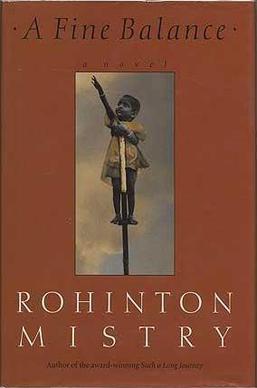
A Perfect Balance By Rohinton Mistry


With A Perfect Balance I continue my exploration into Indian literature. Maybe I am fascinated by the culture or I have been getting lucky with surprisingly great writers. This book is also a part of Oprah’s book club. Now I am not a fan of Oprah’s show, but I can appreciate the things she does and I would love to be able to say that most rich people act like she does. Anyway what I am getting at is her book club has yet to let me down.

Onto the review. The reader starts out the book meeting the four main characters. Aunty Dina, Maneck, Ishvar and Omprakesh. The setting is a flat in a huge city, that is never named, in India. Dina rents the flat and because of certain laws is allowed to stay there without rent increase as long as she can afford it. The problem is since the death of her husband and her increasing age she is unable to afford the current rent. This coupled with the fact that the landlord does what he can to make her move makes things difficult. In order to pay the bills she hires two tailors, Ishvar and Omprakesh. These two make clothes that she sells to a big company. Maneck is the son of Dina’s childhood friend. Maneck is going to school and is a paying guest.

The book then jumps back in time. It follows the early lives of all the main characters until they get to the point at the beginning of the book. From there it continues with this unlikely groups lives and eventual friendship. The book is labeled as fiction, but you know that it is all based on real situations. Dina chooses to get married to a man without the approval of her family. She lives with the constant judgment of her surviving brother. Ishvar and Om leave the countryside because there is no work. The hope is living in the city will bring good fortune. After months of living on the street and in a shack on the side of a railroad track, they finally get to work for Dina. Maneck goes to college to learn refrigeration. He develops friendships that are torn apart by politics.

The book uses the characters to tell the story of India in the late 1970’s. The political upheaval of the time makes crime and extortion the best way to survive. Children are mutilated on the streets so the can gain more money begging. The police will roll into town and sweep everyone off to a work camp to make money for road builders and the politicians and police they pay off. Hundreds of other atrocities are made to “better” the country.

The book is also about friendship. How, even through these hardships, these four unlikely people become a family. The struggle of Dina to care for those that “are below her.” The hotheaded Om accepting someone in a place of power as a friend. The way all the characters grow as people interweaves throughout the book.

The writing is simple, but engaging. You become invested in their lives and feel for their hardships and rejoice at their successes. I think any reader would be drawn into their world and come out better on the other side.

5 Intellectual/ Emotional: The combination of learning about the lifestyle of the people of India combined with the emotional impact the characters provide makes this worth 5.

3 Readability/Style: Mistry’s style is simple and easy to read. Occasionally you are graced with a line that sticks with you, but for the most part it is very bare bones.

3 Long Term Impact: Unfortunately, I feel this book will get lost in amongst the many other great artists writing in India. He is young though and hopefully he will produce mre great work that will bring this to a more popular stage.

11/13 – A great little book. Anyone interested in literature would find this worth the read.

Keep Turning Pages

Wednesday, May 12, 2010

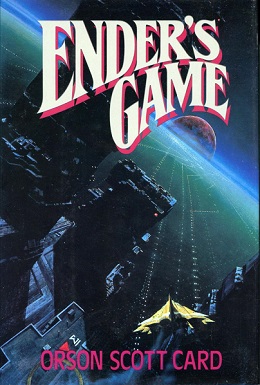
Ender’s Game by Orson Scott Card


Science Fiction 316 pages (Paperback)

Ender’s Game and Orson Scott Card have been on my radar for a long time and was pleased to have a copy lent to me. This book is on many “Best” lists as well as favorite of many people. Keep in mind that I read it after years of reading other science fiction.

Ender is a six year old Third. In the future people can only have two kids and occasionally are given permission to have a Third. The Third is signed up for military service. Ender’s brother and sister were both considered for service, but for different reasons never made the cut. Ender is soon whisked off into space to start training at Battle School. Here they train children the strategy of war in a simulation called the Battle Room. Everyone just calls it The Game.

Ender is pushed to his absolute limits. As soon as he finds a place or masters something the “teachers” move him to another situation. The reader soon learns that Ender is being specifically trained to lead the defense of earth from the “Buggers”. The “Buggers” are a race of insect-like aliens that have invaded the solar system twice. They suspect that another attack is on the way, but humans don’t have a leader to defend against the vastly superior attackers. The hope is that Ender has the ability to make it happen.

Card writes simply and the book is easy to digest. I read the entire book in about a week and never felt bogged down. The book is intended to be a juvenile read, but was interesting enough for an adult. Ender, his brother Peter and his sister Valentine are the only characters that are delved into much.

I felt the book was pretty predictable. At about 2/3’s in I could have told you the ending. I also felt as if some things were made “to easy.” This is basically explained as Ender and his siblings are so intelligent that they could do anything they can think up. Basically, any idea he comes up with is sufficient to do what it needed. Peter and Valentine develop an extremely difficult plan that goes off without a hitch.

I can’t help but look at this from the eyes of a person that has read 100’s of science fiction novels. Ender’s Game is a very influential book. Many books and movies since have stolen the ideas set down here. It came off as predictable to me, but if it were one of my first reads in the genre or I read it in the 70’s I think it would have had a much different impact.

3 Intellectual/Emotional: The ideas are interesting and the inner struggle of Ender is a main part of the book.

3 Style/Readability: Extremely easy read and very easy to keep going, but Cards style wasn’t great or lacking.

4 Long Term Impact: This has already taken its place as a standard in science fiction and it will stay there for a long time.

10 out of 13. A great score for an entertaining book. I think it is worth most reader’s time. It is an easy get away without having to get too involved. For younger readers I would say this is a must read and am disappointed I didn’t have the chance when I was in junior high.

Wednesday, May 5, 2010

Imperial Earth by Arthur C. Clarke


301 pages (Science Fiction)

I have been a huge Arthur C. Clarke fan since I was in high school. In general, his books are insightful, entertaining and engaging. In fact, I had read so many that I didn’t know what books I had read and what I hadn’t. Recently, I picked up Imperial Earth and realized I hadn’t read it. One of the most interesting things about his books is that they all fall within the realm of possibility. Rarely are they about dashing heroes flying across the universe.

Imperial Earth focuses on Duncan Makenzie. He is a 3rd generation clone from Titan, a moon of Saturn. The year is 2276, 500 years the USA came to be. As a representative of Titan he is flying back to Earth to celebrate. His real mission is to use the cloning facilities of Earth to continue his family’s bloodline.

Soon after arriving on earth it is brought to his attention that a large supply of Titanite, an extremely rare and expensive stone only found on the outer planets, is being sold without the Titan government being aware. After some research Duncan finds that a close friend of his is also on Earth and seems to behind these mysterious sales.

Clarke blends his stories unlike most writers. He takes a character and has them in a situation. Typically, they are intelligent people in position of scientific or political power. Once his setting is formed this becomes a background to experiment. He uses his vast knowledge of science to invent and explore the possibilities of what humans will achieve in future. In Imperial Earth humans have colonized the planets of Saturn, settled on Mars and the Moon, developed a fusion drive, live under a world government and have relative peace. Cloning has been mastered, but is still an ethical dilemma. It is interesting to read the book 30 years after it has been written because some of these predictions have already become true. He discusses how people carry a computer in their pockets, Duncan uses something we would recognize as the internet and how the space station is used by people all over the world.

He has a simple way of writing that is easy to digest, but is filled with intellectual and ethical questions. A reader identifies with the main characters and joins in their discoveries. Aome may be put off by a book labeled science fiction assuming Space Aliens and lazers, Clarke brushes these assumptions to the side and produces a modern story you connect with. One of the things I really enjoy about Clarke is he allows the reader to figure things out. He doesn’t always come out and describe exactly what has happened, but requires the reader to put together some of the pieces of the puzzle for themselves. I find this has me more invested in the book.

4 Intellectual/ Emotional: Clarke seems to enjoy taking what might be possible and making it a part of his book. These experiments in the future are a delight to experience. His characters are “real” people whose relationships push the story in certain directions.

3 Style/Readability: There is no problem for most readers to just keep chugging along. At the same time nothing sticks out as remarkable other than his consistency to be entertaining.

3 Long Term: Clarke has always held popularity in science fiction and he will always do so. Even though his stories can be over passed with time they still deal with modern issues even if the technology does not.

10 out of 13: Clarke has written over 40 novels and another 20 non-fiction books. I wouldn’t suggest this as a first read, but realistically any of his books could be picked up and enjoyed by most. I would suggest some of his more famous books such as, Rendezvous with Rama and Childhood’s End.

Keep Turning Pages

Monday, April 26, 2010

Stones into Schools by Greg Mortenson


Stones into Schools by Greg Mortenson

420 pages Hardcover (Non-Fiction)

This is a follow up book to Three Cups of Tea. I will start with a little background to make sense of everything. At the beginning Mortenson attempts to climb K2. While coming down the mountain, after failing to reach the top, he gets lost. After almost starving he finds himself in a tiny mountain village called Korphe. Haji Ali is a town elder and brings the best of everything in the village to help this total stranger. After recovering from his ordeal he wants to help the village for their kindness. He sees the children in “school” in a field, writing in the dirt. He vows to make a school for the village. The first book focuses on the building of that school and how it opens up the floodgates for many more schools to be built in Pakistan.

Stones into Schools takes up roughly were the first book left off. At the beginning of the book a group of Afghani horsemen ride across a pass into Pakistan to meet with Mortenson. They convince him that a school needs to be made for the Kirghiz people in the Wakhan region of northern Afghanistan. He makes a solemn oath to build the school. Unfortunatly, soon after America attacks Afghanistan.

Over the next ten years in the midst of a war and through a major earthquake Moretenson’s organization, the Central Asia Institute, start to build schools across Afghanistan. They are plagued with bureaucratic nonsense, political upheaval, attacks from the Taliban, resistant family members, sickness and natural disasters. Mortenson meets Sarfraz Kahn. He is fluent in many lauguages and has the personality needed to persuade people into doing what is needed. Sarfraz Kahn and the other members of “The Dirty Dozen” work together to start making peace by spreading education. The ultimate goal is to build the school for the Wakhan Kirghiz.

Greg Mortenson writes from the heart. It feels as if he is writing this out to someone close to him. He reveals his owns weaknesses and worries as he attempts to build schools at the “Last Best Place” in the world. I tore through the book easily reading 50 pages a night before realizing I needed to go to sleep. The subject matter is something that is very dear to me: Education and an alternative to war.

5 Intellectual/ Emotional: The whole point is to be doing something constructive rather that destructive. More has been done by a small non-profit organization to encourage peaceful resolution than all the money spent on wars.

4 Style/ Readability: Mortenson presents himself in a humble and straight forward way. It feels as if you are being recounted the major events that he has been involved with. At no point do you get bogged down. You can just keep turning pages.

3 Long Term: As the “current event” status of what is happening with the school wanes so will the popularity of the book. BUT I think that this has the potential to be the start of a whole new way of doing foreign relations. Hopefully those that make these decisions can take from what Mortenson and the CAI has done and make peaceful resolutions rather than bombs.

12 out of 13. I personally feel both of his books should be required reading for most people. When the money it makes to make a bomb could go to make a school and we are still making bombs then there is something wrong with what we are doing. I think anyone with an opinion on how American involves itself in other countries can gain something from both Stone into Schools and Three Cups of Tea.


Keep Turning Pages.

Tuesday, April 20, 2010

The Gardens of the Moon by Steven Erikson


657 Pages PB (Fantasy Fiction)

This book is hard to review. There is so much going on and so many characters and so many factions all intermixed with each other it is hard to know what is going on. After having read the book and am not 100% sure I know what was going on. It is written as if you are living on the world. You already know what has happened in the past so you are only told what is happening now. Some things that happen now aren’t explained enough to know what really happened. You throw in some magic explosions, portals and warring armies and gets confusing. Oh yeah, some gods come up to mess with things. Some people die and come back to life. Some die and turn into evil puppets and some live for thousands of years.

Let’s see if I can make some sense of it all.

Empress Laseen rules the Malazan Empire. Her goal is total domination. The jewel of the continent, Darujhistan, stands yet untaken. The siege of Pale is finished and Sergeant Whiskeyjack and his Bridgeburners have been sent to infiltrate this ancient city. Here they hope to encourage the city to become a place of complete chaos once the Empire shows up.

The Assassins are on the brink of war within the city and it is dangerous times to be on the rooftops. Rumors claim of the Empire’s Claw assassins have entered the city and are looking to cause trouble.

Lorn, a high ranking official in the Empire, is searching in the hills looking to wake an ancient force. The Jaghut, a member of an ancient race, was imprisoned within the earth thousands of years ago. Lorn has been sent to release that power.

The men at the Phoenix Inn have agendas of their own. Kruppe, a babbling old wizard, that seems to have his hand involved in a little of everything. Crokus has fallen in love with a maiden who’s standing does not allow him a chance. Rallick is intermixed with the problems of the assassin’s Guild.

Paran is a noble born officer in the Empire. He is put in a command of the after fall of Pale. He is quickly killed. Before walking through the gates of the afterlife the Gods of Luck, Oponn, stop him and give him his life back. Just before he returns to the land of the living he sees, Shadowthorne, King of the High House Shadow and his Hounds. They beckon him through the gate. He stands up against them, but in doing so makes some enemies. His relationship with the gods is not fully revealed, but from that point on he becomes a pawn in a much greater game.

The tales of these characters as well as MANY others are intertwined and clashed together in this book. Stephenson was nice enough to include a glossary of sorts to help identify the various characters, factions and places. The beginning of the book can be hard to follow. As the book goes on you do start to understand who is who. It feels very much like this is the start of epic tale. It is the first of 10 books. I have been told that the following book makes this even easier to follow.

The writing is very rich and descriptive and the characters are unique and you sympathize with those on both “sides” of the war. That being said I did find it difficult to really get “into” the book. Many times with a fantasy book such as this I get lost in the story and don’t want to put it down. With Gardens of the Moon this wasn’t as apparent. This mostly had to do with the confusion. Not knowing exactly what was happening made it hard to get involved. That said, when I finished the book I wanted to start over again. Now that I have an understanding of what was going on a second read would make it all make sense.

4 Intellectual/Emotional: The characters are deep and well written. Although it’s in a fantasy world the characters act “real.” The Empire is dominating the world, but you feel for the characters that are “fighting” on the Empire’s side. The unending list of characters and places are enough to keep any reader busy keeping them all straight.

3 Style/ Readability: Stephenson writing style is Epic and engaging. It is difficult to keep track of it all and that makes the readability suffer. It seems to me that it will be worth it as you continue into the books.

3 Long Term Impact: This is one of the hardest to judge. I certainly has the potential to be a hit for the long term. It stands in the same category of Epicness as Martin, Jordan and Tolkien, but could get lost with so many competitors considering is difficulty to get through.

10 out of 13. A fine score for a lesser known book. I certainly will read the next in the series. I don’t think this is a good starting point for people just trying out fantasy, but many dedicated fantasy fans will find this worth their time.

Tuesday, April 13, 2010

The Color of Magic by Terry Pratchett


210 Pages PB (Fantasy Fiction)

This is the first in a series of books that all involve a world called Discworld. It is a disk floating though space on the back of four enormous elephants. These in turn are standing on the shell of an even bigger turtle. Pratchett takes the fantasy genre and turns it on its ear for a humorous and fun ride.

Rincewind is a pretty unfortunate wizard. In fact, he isn’t much of a wizard at all. In fact, in fact, he only knows one spell. And he can’t use it. Most likely it would destroy the world. He isn’t sure. Death is on his tail, but he is doing everything he can do avoid the appointment.

Twoflower is a tourist from the other side of the disc. Luckily for him gold is very easy to come by where he comes from. What he considers a normal tip for a small service is enough to keep a family happy for many years. He has a set of Luggage. This Luggage is a fantastic magical device that will protect and follow its owner anywhere.

Twoflower offers to hire Rincewind as a guide. Unfortunately, the city is soon consumed by a terrible fire. This sends the two into the wild country side of Discworld.

The book is broken into 4 chapters that cover the length of their journeys. Each one has its own story, but involves the same main characters. Rincewind and Twoflower find themselves in the tomb of a forgotten god, fight in an upside down mountain where dragons are made with a thought and find themselves captured by water fearing wizards when they thought they were about to fall off the edge of the world.

Pratchett has an entertaining way of writing. He uses plays on words and unexpectedly spins “traditional” fantasy so that it is very engaging. Since the world is filled with magic many impossible things are easily done and he uses it in a creative and humorous way.
I found myself laughing at parts, but the book wasn’t so silly as to turn a reader off. This leads to having a lighthearted feel. The book is also very fast paced. The “heroes” are swept from here to there encountering all types of strange people and fantastic places.

2 Intellectual/Emotional: The books focus is to have fun in a magical world. It really doesn’t get too deep.

5 Style/Readability: This is where this book shines. Pratchett’s humor reminds me of Douglas Adams, but has his own style and it is filled with creative ideas that you won’t expect. It is also an extremely easy read.

3 Long Term: It was printed over 25 years ago. I have heard about him for many years and sadly hadn’t read him until now. I sure this book and series will be popular for some time. I certainly intend to read more.


10 out of 13

I feel having a large background in fantasy reading made this even more enjoyable. It takes your view of what is possible in a “Magic Place” and makes fun of it. I think most readers would find this a quick and fun book, but fantasy fans would have even more to enjoy.

Tuesday, March 2, 2010

Change of Rating!

So I am changing how I rate books (again). I found that some books were being graded low that I actually liked more than my rating would reveal. The main issue was I had categories for intellectual and emotional. Although I feel these are important parts to consider in a book I found they were often at odds with each other. Some books focus on intellectual achievement and others on emotional. I also felt that how a book reads wasn’t a part of my system and is also important. SO here is my new grading system:

As always the system will go up to 13 points. 4 in each category with a bonus point available to put in special cases I feel warrant it.

Intellectual-Emotional Impact

Rather than have these qualities at odds with each other I have combined them. If the book focuses on one or the other I will describe that accordingly.

Readability-Style

Some books are easy to read and you can’t put them down. Some authors writing styles are just a joy to read. This will rate that.

Long-term Impact

This piece will remain the same. Many books hit the best seller list, but few are still popular 50 years later.

As always I will attempt to explain my reasoning along with the points.

Keep Turning Pages!